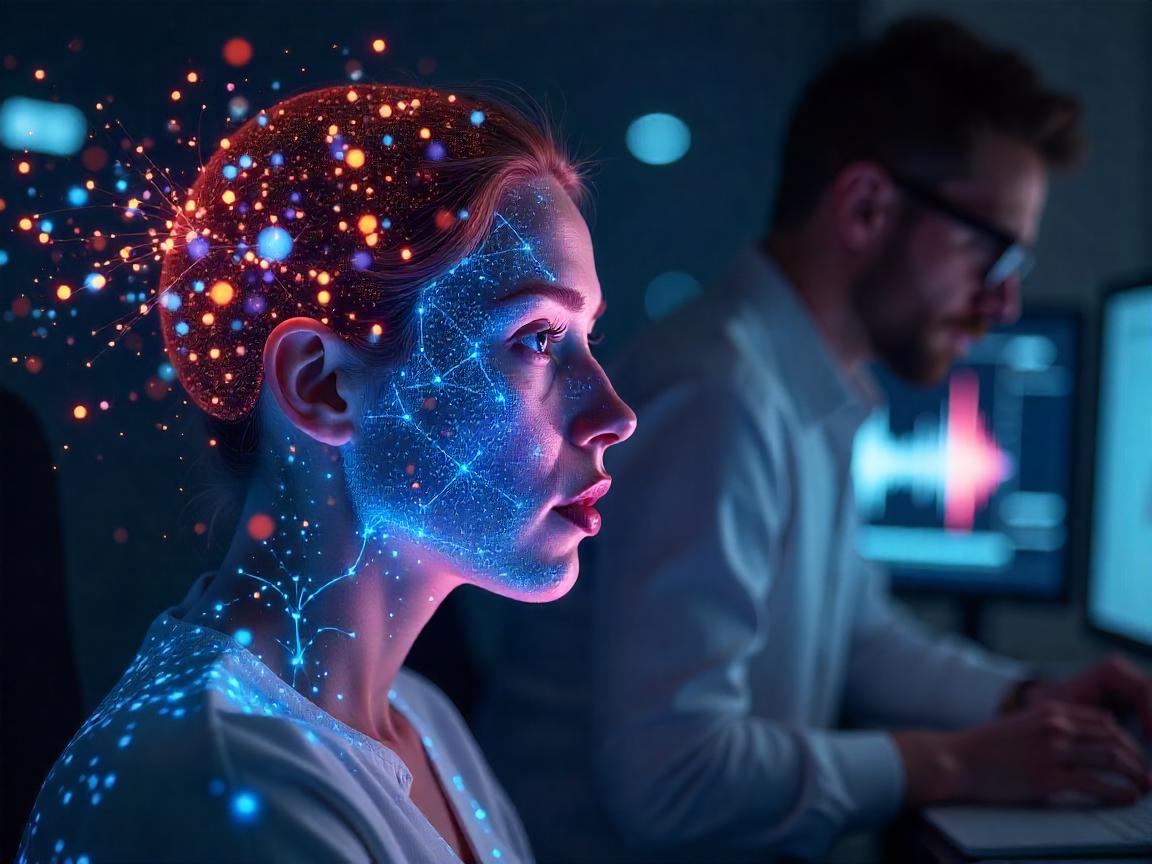
From Monotone Machines to Expressive Storytellers
At one point in time there were artificial voices that sounded as they would have fit in a low budget science fiction film, the unnatural tone, the stilted and impoverished nature of the voice was something that you will definitely not attribute to anything that would be remotely human. However, today, when you put it on and bend your ear, you will hear a revolution buzzing in your headphones. Diffusion transformers, in addition to their offspring have already solved the riddle of how to make speech feel alive. It is not just putting words in the right order but it is the little increase and decrease of the pitch, how a sentence protrudes as you are curious or how a sentence plunges as you are doubtful.
The first time I heard the Emotion Studio product of ElevenLabs read me a children book apple-pies voice and quiet exasperation, I almost forgot that the voice behind the microphone belonged to an algorithm. It was a thrilling moment, it was sinister too, and we have passed over the border.
The Secret Ingredients of Natural Speech
But what does one need in order to train a machine to actually sound human? In all its simplest form, prosody is the music of language. It is the beat, the stress and the tune which conveys emotion beyond the lines. In voice, micro-expressions are small pauses, breathy terminations, that make voice sound intimate. Speechmatics research conducted in 2024 revealed that more than 90 of people who listened to rich-prosody voices considered them more trustworthy than their monotonous counterparts. This is not just some facelift. Such transformers as diffusion transformers used in the VALL-E 2 of DeepMind are trained to learn these details, in successive repetitions of predictive and ameliorative refinement over thousands of training periods, each one layer of expressiveness upon another. Such a process is sort of like sculpting: crude features end up as fine details by doing the same thing over and over.
How Diffusion Transformers Became So Good
It took time to bring the character out of the robotic recitation and shape a plausible performance. The diffusion transformers are making a difference since they represent whole sequences in parallel, which older autoregressive models had no chance to accommodate. To give an example, previous system such as Tacotron could only handle short, simple sentences but failed to succeed on longer passages where emotion was required to increase and defuse. In comparison, VALL-E 2 presented a 20 percent gain in emotional fidelity over multilingual test sets as per the 2025 benchmarks of Google DeepMind. This change can be explained why in spite of your attempts to get a smart speaker to sound genuinely empathetic, it now finally will succeed. These models seem to learn how to guess where your voice wishes to go next and then follow it there with iron accuracy.
Training on a World of Data
Amazing chunks of different data energize this new wave of realism. ElevenLabs, to take one example, has gathered more than 500,000 hours of annotated recordings of everything including poetry readings and legal arguments. They taught the models to match words to sounds and also to emotions and delivery using each clip. Let me know if you’d like this rephrased further! So here is why it makes a difference: a term like I am alright can be a term of consolation or it can burn with sarcasm, according to intonation. This is the most interpretive art sense that the AI has ever felt to me.
ReplicaSound built in one pilot project a system that reproduced the style in which a popular podcast host spoke, including his distinctive pauses and amused sighs. The effect was so realistic that some of the audiences believed that the host has recorded additional episodes behind their back.
The Risks We Shouldn’t Ignore
Naturally there are severe dangers behind all this flashy ability. Dr. In a recent WIRED interview, Aisha Karim of the Stanford school cautioned that human presence can no longer be confirmed via emotional authenticity. It is a radical change. And to the extent that AI can reproduce our compassion and affability it can use them against us in the form of fraud or propaganda. Can you imagine that someone called you in the name of a grandmother and asked you to help them in an emergency situation as soon as possible-how sure would you feel that it was really your grandmother? On a personal note, I would like there to be clear standards on consent and watermarking before this tech goes everywhere. Otherwise, we will be open to a future in which intimate communications can easily be, but plausibly, forged.
Where Do We Go From Here?
It would be unwise to claim that these generative models are not brilliant or that they do not open up new creative areas. Still, there is an even more fundamental question that we have to tackle, and that is, in the event that our machines are able to replicate our cacophony with complete prosody and micro-expressions, then what is it that we can hold on to which is distinctly, inimitably human? At this moment, I am hopeful, yet desiring nothing more than diminishing the health of my future. However, when you hear a familiar, comfortable voice again, sounding out of a screen next time, spare a thought- who, or what, is actually talking to you?